
.jpg)






For Asian businesses operating in Europe, Pillar Two is now a practical question of tax exposure, data and filing responsibilities. A European subsidiary may have obligations even where its own revenue is modest, its corporate tax rate exceeds 15%, or its parent country takes a different approach to implementation.
This guide explains what Pillar Two means, how tax exposure is assessed, and how reporting works for Chinese, Korean and Japanese groups in Europe.
1. What is Pillar Two
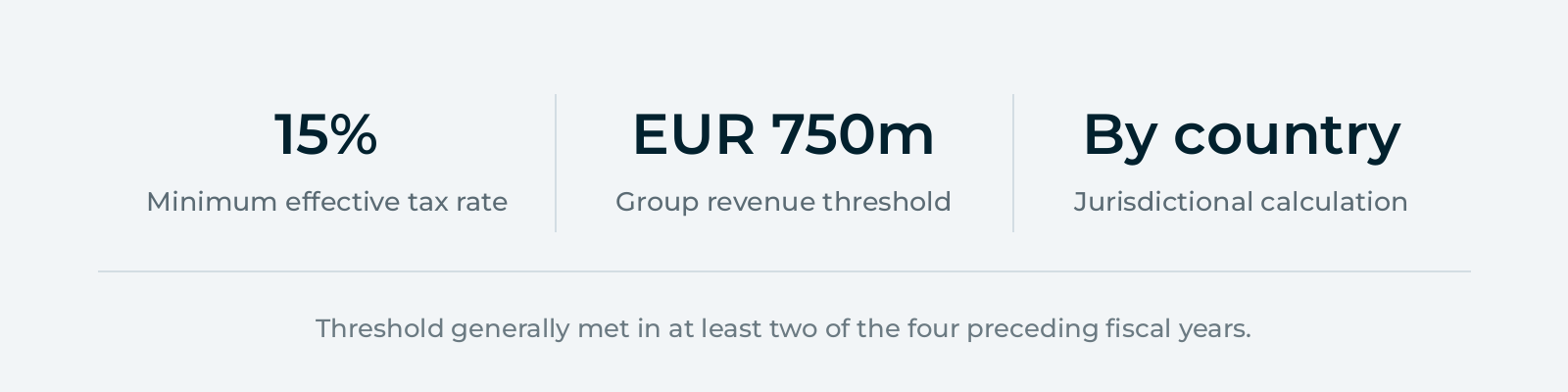
Pillar Two is the OECD/G20 framework for a global minimum tax. This article focuses on its Global Anti-Base Erosion rules, known as GloBE. Within the EU, these operate through Directive (EU) 2022/2523 and national legislation, rather than a single directly applicable EU regulation.
Key terms in plain English
| Term | What it means |
|---|---|
| GloBE | Global Anti-Base Erosion rules — the minimum tax rules covered here. |
| Group entity and UPE | A constituent entity is a covered group company or permanent establishment. The UPE is the ultimate parent at the top of the group. |
| ETR and top-up tax | ETR is the effective tax rate under Pillar Two. Top-up tax is the extra tax that may arise below 15%. |
| Safe harbour | A simpler route to a tax result when specified conditions are met. |
| GIR | GloBE Information Return — the group’s Pillar Two information report. |
| CbCR | Country-by-Country Reporting — group data also used for some safe-harbour tests. |
Three further terms identify who collects the tax: QDMTT, IIR and UTPR. They are explained in the next section.
2. How tax exposure is assessed
Start with these four checks
- Check group size. The usual threshold is consolidated revenue of at least EUR 750 million in two of the previous four fiscal years. It applies to the group, so a small subsidiary can be covered. The EU also covers large domestic groups; certain entities, such as qualifying pension funds and some investment-fund parents, are excluded.
- Test available safe harbours. Check whether a simpler calculation is allowed for the jurisdiction and year before completing the full calculation. Keep supporting evidence and make the required election.
- Calculate the effective rate where needed. Use Pillar Two income and tax figures for each jurisdiction. Tax incentives, accounting differences and deferred taxes can change the result. A headline corporate tax rate above 15% does not settle the question.
- Assess any extra tax. An ETR below 15% may lead to top-up tax on excess profits, after an exclusion linked to eligible payroll and tangible assets and other applicable adjustments.
How a safe harbour helps
Think of a safe harbour as a conditional simplification. For example, the Transitional CbCR Safe Harbour can treat the relevant GloBE top-up tax as zero if qualifying data meets one of these tests:
- Revenue and profit are below specified limits (CbCR revenue below EUR 10 million and profit before tax below EUR 1 million).
- The simplified effective tax rate meets the transition rate (15% for 2023–2024, 16% for 2025 and 17% for 2026–2027).
- Profit does not exceed the exclusion linked to payroll and tangible assets.
Duties that remain. The group still needs evidence and information reporting. Domestic top-up tax must be checked separately. A safe harbour does not take the group outside Pillar Two.
Who collects the extra tax
| Order | Rule | Usual role |
|---|---|---|
| First | QDMTT | Qualified Domestic Minimum Top-up Tax: the jurisdiction where profits arise collects locally. |
| Next | IIR | Income Inclusion Rule: a parent is taxed on its share of low-taxed group income, taking account of domestic top-up tax. |
| Backstop | UTPR | Undertaxed Profits Rule: residual top-up tax is allocated to implementing jurisdictions where the group operates. |
Example: a Korean group with a low-taxed Czech operation first assesses Czech domestic top-up tax, then the Korean parent’s IIR position. A QDMTT safe harbour may reduce duplicate calculations.
3. Country differences and recent changes
Where your group is headquartered affects which country may collect additional tax and when the rules apply. Japan and South Korea have introduced Pillar Two rules, so groups must coordinate their headquarters’ calculations with their European subsidiaries’ obligations.
| Headquarters | Rules and starting dates |
|---|---|
| South Korea | January 2024: IIR applies to low-taxed overseas profits. January 2025: UTPR backstop begins. January 2026: domestic top-up tax begins for profits earned in Korea. |
| Japan | April 2024: IIR applies to low-taxed overseas profits. April 2026: UTPR and qualified domestic minimum top-up tax (QDMTT) begin. |
| Mainland China | EU Pillar Two rules can apply even if mainland China has not introduced equivalent rules. If top-up tax is not collected locally or under the IIR, EU countries that apply the UTPR may collect it through that rule. The Transitional UTPR Safe Harbour can protect profits in China, as the parent jurisdiction, for fiscal years beginning in 2025 or earlier. However, from 2026, similar protection is available only if the parent jurisdiction has a Qualified UPE Regime recognised by the OECD/G20 Inclusive Framework. Hong Kong applies its own IIR and domestic minimum top-up tax from 1 January 2025. |
How to read the dates. These are financial-year starting dates, not payment or filing deadlines. For example, “April 2024” means financial years beginning on or after 1 April 2024. For a Japanese company with a January–December financial year, the first covered year would therefore begin on 1 January 2025. Likewise, Japan’s April 2026 UTPR and QDMTT first apply to such a company from 1 January 2027. The Korean dates already start on 1 January.
What changed in 2026
More time for transitional relief. The Transitional CbCR Safe Harbour lets eligible groups use Country-by-Country Reporting data instead of full Pillar Two calculations. It now covers fiscal years beginning by 31 December 2027 and ending by 30 June 2029. For years beginning in 2026 and 2027, the simplified ETR test uses a 17% rate. Whether it applies depends on each country’s own rules.
New simplifications. The Simplified ETR Safe Harbour generally starts in 2027, offering an easier way to demonstrate an effective tax rate of at least 15%. A Substance-based Tax Incentives Safe Harbour starts in 2026, helping preserve certain tax benefits linked to local spending or production. Both require eligibility checks and a formal choice to use the relief, subject to local implementation.
Special regime relief. The Side-by-Side Safe Harbour can remove IIR and UTPR exposure for qualifying groups, while the UPE Safe Harbour protects only the parent jurisdiction from UTPR. The United States currently has a Qualified Side-by-Side Regime; UPE Safe Harbour eligibility should be checked against current OECD information. Local QDMTTs can still apply.
Different accounting calendars. A different local accounting year does not automatically prevent QDMTT Safe Harbour relief. OECD guidance explains how the safe harbour works when local and group reporting periods do not match. Local rules may still require specific accounting standards, and groups may need to test more than one local period.
4. How Pillar Two is reported
Central filing. Central filing can remove separate local GIR filings when the filing, notification and information-exchange conditions are met. Local notifications, tax returns and payments may still be required. Within the EU, GIR information is exchanged under Directive (EU) 2025/872 (DAC9). Exchange with countries such as Japan and Korea depends on an active OECD GIR MCAA exchange relationship or another qualifying agreement.
| Filing route | Main condition |
|---|---|
| Ultimate parent files | A qualifying exchange arrangement must be in effect between the filing jurisdiction and the subsidiary’s jurisdiction for that reporting year. |
| Designated group company files | A Designated Filing Entity files centrally. The same cross-border filing and exchange conditions apply. |
| One local entity files | A local group entity may be permitted to file for other group entities in the same jurisdiction, subject to local rules. Cross-border relief depends on the applicable central-filing and exchange arrangements. |
| The subsidiary files locally | The subsidiary files its own GIR unless local filing is switched off through qualifying central filing elsewhere. |
First-year filing relief: what it means for Japanese and Korean groups
For the 2024 reporting year, an OECD common understanding allows participating jurisdictions to waive penalties or suspend enforcement of local GIR filing where the GIR was centrally filed on time in a listed jurisdiction and the required local notification was made. The relief applies only to local GIR filing; other filing, notification and payment obligations remain separate.
- Deadline: For calendar-year groups first subject to Pillar Two in 2024, the first GIR was due by 30 June 2026.
- Country limits: Poland gives relief only where the GIR is centrally filed in a listed EU Member State. Slovakia gives relief only where it has an activated exchange relationship with the central filing jurisdiction.
- Follow through: Local GIR filing may still be enforced if the centrally filed information is not exchanged by 31 December 2026.
Discuss your European position with Moore EU Asia
If your group is headquartered in China, South Korea or Japan and operates in Europe, start with a clear view of where Pillar Two applies and who owns each obligation. Contact Moore EU Asia to discuss your European structure, local requirements and coordination with your headquarters team.
This article provides general information as at 25 September 2026 and does not constitute advice on a specific tax position. The applicable domestic legislation, fiscal year and group circumstances must be assessed.

